
Image:

The Portugal Policy Lab is led by three institutions: the Alentejo Regional Development Agency (ADRAL), Instituto Superior de Agronomia and Universidade Nova de Lisboa.
The Alentejo Region represents almost a third of the country's surface but only 5.2% of the population. This low density, combined with a diversity of landscapes that vary from the coastal area to the interior, create a unique mosaic of ecological, aesthetic, symbolic and material values.
Over the decades, the natural and cultural image of the region has been shaped by the open fields associated with the production of cereals and pastures, as well as areas of arable crops, where cork oak and holm oak agroforestry systems have been playing vital roles in supporting the local economy, preserving biodiversity and maintaining the natural balance of the region.
However, transformations in the Alentejo landscape over the last 30 years have been accompanied by an increase in intensity of land use. These uses include intensive olive groves throughout the region, particularly in the Alqueva area, greenhouses installed on the coast and the increasing construction of photovoltaic plants.
Considering the effects of climate change and biodiversity loss in the Alentejo Region, it's crucial to discuss the significance of restoring ecosystems and preserving water and land as vital resources. This leads to the necessity of addressing the future of the Alentejo from a perspective of co-creating territorial policies that integrate socioeconomic needs with the landscape's ecological sensitivity, while preserving its regional identity.
Image:
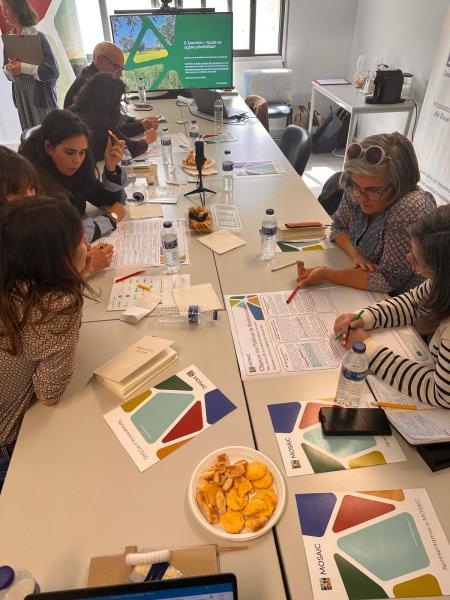
Recently, the lab conducted extensive interviews with land users and organisations to capture drivers of land use change and personal motivations in the decision-making processes at both a high level and farm level. An EPIC WebGIS module has been developed to visualise future land-use scenarios for the region and has supported the Policy Lab activities by facilitating the exploration and discussion of alternative land-use pathways.
The Alentejo Policy Lab revealed that access to irrigation is a key dimension of social equity, as differences in water availability shape contrasting opportunities and constraints among land users across the region. Beyond these territorial inequalities, the process also exposed gaps in knowledge and understanding of land-use policies, while fostering dialogue, mutual learning, and collaboration among diverse stakeholders, including beekeepers and livestock managers.
Drivers of Land Use Change
The expansion of irrigation infrastructure has created a sharp divide: intensive monocultures such as olive groves and greenhouses are thriving while traditional systems are in decline. Solar farm expansion is another major driver, often competing with agriculture for land due to the region's high solar radiation. Socio-demographic vulnerabilities, including depopulation and ageing, are also creating pressure to promote profitable, market-driven activities like tourism over traditional farming. Institutional drivers include excessive bureaucracy and a lack of regional planning, which has allowed for rapid, unregulated monoculture expansion.
Next steps
The continuation of the Alentejo Policy Lab represents an opportunity to further develop a shared understanding of land-use challenges and potential transition pathways. Future workshops will focus on Nature-Positive Future (NFF) scenarios, using spatial outputs as boundary objects to facilitate dialogue, validate alternative futures, and identify enabling conditions and barriers for sustainable land management. The knowledge co-produced through the Policy Lab may further support regional planning processes, including the Regional Spatial Plan for Alentejo (PROT-A), by providing stakeholder-informed insights into future land-use challenges and opportunities.